Sunday, June 14, 2009

Smoking & Breast Cancer


The Link

“Smoking causes breast cancer. So does second-hand smoke.”

These are the conclusions of a Canadian-led panel that poured over more than 100 recent studies in search of the linkages.

Anthony Miller, associate director of research at the University of Toronto’s Dalla Lana School of Public Health said that for a long time, there had been academic debate on the link between breast cancer and second hand smoke. As recently as 2006, a U.S. Surgeon General report had determined that research evidence was “suggestive but not sufficient”.

“But our reanalysis of all the evidence, we concluded something quite different,” said Miller in a published news report in Toronto Star in April.

The panel found evidence that smoking could increase breast cancer risks by 40 to 50 per cent in some cases. And in genetically susceptible women the risk could be doubled, he said.

The new analysis also showed that there was a significant link between breast cancer and second hand smoke in pre-menopausal women and a strong connection between the illness and active smoking in women of all ages.

Although there is not yet enough data to determine how many cases of breast cancer could be traced directly back to tobacco, the report should help to curb smoking among women, for whom breast cancer often holds a unique and particular terror, Miller said.

Women Smokers in the Philippines

Breast cancer is the second leading type of cancer in the Philippines and the first among women with risks increasing after age 30. In Asia, the Philippines has the highest incidence rate of breast cancer and is considered to have the ninth highest incidence rate in the world today.

In Southeast Asia, the Philippines has the highest smoking prevalence among young women. The Tobacco Atlas 2009 also puts the Philippines at No. 16 among the list of Top 20 countries with the highest female smoking population in the world. This is translated as roughly 12.3% of adult females smoke. This is far worse compared to the 2006 list that placed the Philippines at No. 26.

Smoking prevalence among adult females in the Philippines is twice higher than in China, India, Indonesia, Thailand, Vietnam, Malaysia, or Singapore. In the said Asian countries, the said prevalence, based on standardized data, is between 1-4% while the Philippines is already at 8.5%.

As for the female youth in the country, the Global Youth Tobacco Survey (2007) revealed that 19.6% of girls aged 13-15 smoke while more that 60% of girls are said to be exposed to second hand smoke.

---
Photo from Flickr

Lost Voice from Smoking

Emer Rojas is not a health worker but he is the most credible speaker
on the ill effects of smoking. But alas, this speaker lost his voice

to laryngeal cancer because of smoking.


“We all need to be reminded every now and then of what cigarettes can do to our lives and to our family.” Emer Rojas - an IT business owner, trade lecturer and radio host – said his life will never be the same again because of smoking. He lost his voice to laryngeal cancer.

A chain smoker since he was 18, Emer was diagnosed with cancer in November 2002. Almost immediately, his larynx, a source of vocal tone in speech, was removed by surgery. In January 2003, he underwent another operation to widen his stoma, the mouth-like opening on his neck.

The medical expenses for his check-ups, examinations, surgeries and radiotherapy and chemotherapy sessions left a drain on his family’s pocket. And like other type of cancers, laryngeal cancer might return after treatment, so he still spends P5,000 to P16,500 every month to monitor his condition. The expenses are for testing his blood chemistry, ultrasound, CT scan, or magnetic resonance imaging.

With the aid of an electrolarynx, a device pressed against the skin of the neck to produce vocal sounds, he said that having cancer drains the family’s financial reserves, as well as prevents one from earning a living.

Cancer also changed his lifestyle. He says: “Losing one’s voice is like losing your sight or hearing. It is recognized as one of the permanent disabilities in the Philippines. It affected me as a radio announcer and a mentor in training institutions. It also prevents me from doing the normal business communications and chores.”

Rojas misses the time when he could still travel. Now, he can no longer play basketball or tennis, afraid that he might break a bone.

“I miss my social life. I was always with my peers, having a cup of coffee, talking,” he says. “When we are in a public place and it’s too noisy, my friends won’t understand me. So I keep quiet or I just talk to them through email.”

Rojas learned this lesson the hard way, and he wants to spare the youth—the new target market of cigarette companies—from a similar experience. Today at 50, Emer makes the rounds of schools in Metro Manila and key cities across the country, encouraging young people to avoid smoking.

He’s not a doctor or a health worker, but he is a most credible speaker on the ill effects of smoking.

In 2003, he joined the Philippine Laryngectomy Club (PLC), a group that helps rehabilitate laryngeal cancer patients, and became its president. In 2007, he formed the New Vois Association doing anti-smoking advocacy and networking activities.

---
This was also posted on MENstream.

Saturday, June 13, 2009

Smoking is “Haram” (Forbidden)


Dr. Tahir B. Sulaik, Secretary of Health of the Autonomous Region in Muslim Mindanao (ARMM), said that “eminent Muslim Scholars have issued Fatwas (Islamic Rulings) declaring that cultivating and/or trading and/or smoking tobacco or cigarette is undoubtedly Haram (forbidden) in Islam and that the Supreme Council of Darul-Ifta of the Philippines based in Cotabato City unanimously ruled that cigarette smoking is deemed Haram.”

This statement is embodied in his letter to House Deputy Minority Leader Didagen Dilangalen to support tobacco control legislation, particularly House Bill 3364 or the Picture-Based Health Warning on Cigarette Labels bill which is still pending despite the Philippine deadline for compliance under the international treaty laws (or the Framework Convention on Tobacco Control) last September 2008.

This timely announcement boosts the anti-tobacco efforts of various sectors this month – the No Smoking Month.

---
Photo from the Internet.

Friday, June 12, 2009

US Landmark Bill To Regulate Tobacco


The US Senate votes to allow the Food and Drug Administration (FDA) to regulate tobacco which President Obama has said he will sign it into law as soon as it reached his desk.

The New York Times report by Duff Wilson published on June 11, 2009 has summarized the new policy on tobacco:

What the FDA Could Do Under the Bill

• Set up a Center for Tobacco Products financed by industry fees, hire a director and staff, and form a scientific advisory committee.

• Adopt standards to regulate hazardous chemicals in existing tobacco products.

• Approve or ban proposed new tobacco products.

• Prohibit use of terms like “light”, “mild” and “low tar.”

• Eliminate flavorings like clove. Consider eliminating menthol.

• Require larger, graphic warning labels on cigarette packs.

• Further restrict advertising and promotion of tobacco products.

• Require tobacco companies to disclose previously secret details about ingredients.

What the FDA Could Not Do

•Ban al tobacco products.

• Order the complete removal of nicotine from tobacco products.

• Raise the national minimum age to purchase tobacco products above 18 years.

Main Difference between Senate and House Bills

• On cigarettes, Senate bill requires graphic warnings covering at least 50 percent of front and back of cigarette package. House bill requires warnings covering at least 30 percent.

More than four decades after the surgeon general declared smoking a health hazard, the Senate cleared the final hurdle to empowering federal officials to regulate cigarettes and other forms of tobacco for the first time.

When will the Philippine Congress follow suit? Charter Change or Health?!? Huh!#@&%

---
The photo shows a classic tobacco print ad in the US,
with beautifully crafted message to lure smokers.
Taken from the Internet.

Thursday, June 11, 2009

Hail, Hale!


HALE – a four-piece alternative rock band in the Philippines – has been jointly recognized by the World Health Organization, the Department of Health and the Framework Convention Alliance on Tobacco Control Philippines for their exemplary contribution to, and as a champion of, tobacco control advocacy. The award was given during the World No Tobacco Day smoke-free concert at the Rajah Sulayman Park in Manila on May 31.

Champ Lui Pio, the band’s lead vocal and guitars, said he has asthma and hates the smell of cigarette smoke. He vowed that he will continue to involve himself and his band in anti-tobacco/anti-smoking efforts to prompt the youth to stop smoking or not to pick up the habit. The members of the band include Roll Martinez (guitars, vocals); Sheldon Gellada (bass, vocals); and Paolo Santiago (drums, percussion).

Hale hits off melodiously well with the hopelessly romantic Filipino audience. Their impact is felt everywhere you hear their song “Broken Sonnet” and “The Day You Said Goodnight”-- the songs that have sent young hearts pumping into overdrive.

Monday, June 8, 2009

The Smoker's Body


It is not always cancer or heart disease that kills smokers. There are a lot more…

HAIR LOSS. Smoking weakens the immune system leaving the body more vulnerable to diseases such as crythematosus which can cause hair loss, ulceration in the mouth and rashes on the face, scalp and hands.

CATARACTS. Smoking is believed to cause or worsen several eye conditions. Those who smoke more than 20 cigarettes a day are twice likely to develop cataracts – a clouding of the eye lens that blocks light and may lead to blindness. Smoke causes cataracts in two ways: by irritating the eyes and by releasing chemicals into the lungs that then travel up the bloodstream to the eyes.

WRINKLING. Smoking prematurely ages skin by wearing away proteins that give it elasticity, depleting it of Vitamin A and restricting blood flow. Smoker’s skin is dry, leathery and etched with tiny lines, especially around the lips and eyes. In one study, smokers in their 40s had facial wrinkles similar to those nonsmokers 20 years older.

HEARING LOSS. Because smoking creates plaque on blood vessel walls, decreasing blood flow to the inner ear, smokers can lose their hearing earlier than nonsmokers (up to 16 years sooner, according to one study) and are more susceptible to hearing loss caused by ear infections or loud noise.

SKIN CANCER. Smoking does not cause melanoma (a sometimes deadly form of skin cancer), but it does increase your chances of dying from it (this may be because smoking impairs the immune system). And smokers have a 50 percent greater risk of contracting squamous cell carcinoma – a cancer that leaves scaly, reddish eruptions of the skin.

TOOTH DECAY. Smoking interferes with the mouth’s chemistry, creating excess plaque, yellowish teeth and contributing to tooth decay. Smokers are one and a half times more likely to lose their teeth.

LUNG AILMENTS. In the Soviet bloc, around 88,000 smokers die each year from debilitating lung conditions other than lung cancer. Emphysema is a swelling and rupturing of the lung’s capacity to take in oxygen (and expel carbon dioxide). In extreme cases, a trachetomy helps patients breathe. An opening is cut in the windpipe, allowing a ventilator to force air into the lungs. Chronic bronchitis, on the other hand, creates a build-up of puss-filled mucus, resulting in a painful cough and breathing difficulties.

OSTEOPOROSIS. Carbon monoxide, the main poisonous gas in car exhaust fumes and cigarette smoke, binds to blood much more readily than oxygen, cutting the oxygen-carrying power of heavy smokers’ blood by as much as 15 percent. As a result, smokers’ bones lose density, fracture more easily and take up to 80 percent longer to heal. Those who smoke more than one pack per day are more susceptible to back problems. One study shows that industrial workers who smoke are five times more likely to experience back pain after an injury.

HEART DISEASE. Smoking-related cardiovascular disease kills more than 600,000 people each year in the world’s developed countries. Smoking makes the heart beat faster, raises blood pressure and increases the risk of hypertension and clogged arteries.
STOMACH ULCERS. Smoking reduces resistance to the bacteria that cause stomach ulcers. It also impairs the stomach’s ability to neutralize acid after a meal, leaving the acid to eat away at the stomach lining. Ulcers in smokers are harder to treat and more likely to recur.

DISCOLORED FINGERS. The tar in cigarette smoke collects on the fingers and fingernails, staining them yellowish-brown.

CERVICAL CANCER. Besides increasing risk of cervical cancer and uterine cancer, smoking can create fertility problems for women and complications during pregnancy and child birth. And smoking lowers estrogen levels, speeding up menopause.
DEFORMED SPERM. Smoking can deform sperm and damage its DNA, causing miscarriage or birth defects. In fact, men who smoke more than 20 cigarettes a day have an extra 42 percent risk of fathering a child who contracts cancer. Smoking also diminishes sperm count and reduces the blood flow to the penis, sometimes causing impotence.
PSORIASIS. Smokers are two to three times as likely to develop psoriasis, a non-contagious inflammatory skin condition that leaves itchy, oozing red patches all over the body. While researches are not sure how smoking aggravates psoriasis, they hypothesize that smoking may alter white blood cells or release high levels of toxic chemicals.

BUERGER’S DISEASE. Smoking can damage blood vessel walls, making it difficult for the heart to pump blood to the extremities. In serious cases, Buerger’s disease can lead to gangrene (the death of body tissue) and even the amputation of a limb.

CANCER. At least 60 elements in tobacco smoke have been shown to cause cancer, according to Action on Smoking and Health, an anti-smoking group in the UK. Male smokers are 22 times more likely to develop lung cancer than nonsmokers. And according to a number of studies, the longer one smokes, the greater the risk of developing a number of other cancers, including cancer of the nose (2x greater); tongue , mouth, salivary gland and pharynx (6x for women and 27x for men); throat (12x); esophagus (8-10x); kidneys (5x); penis (2-3x); and anus (8-9x). The link between smoking and breast cancer is perhaps the most controversial. While some evidence suggests smoking increases a woman’s risk of developing the cancer, other evidence indicates that, by lowering estrogen levels, smoking actually reduces the risk.

---
Philippines Department of Health poster

designed by Nong Mendoza

Graphic Health Warnings Now!


Neighboring Countries with Graphic Health Warning.
Last box translation: Philippines, When? Wake Up!

Filipinos cannot relate with cigarette pack warnings as a result of English-only textual health warning labels. Recent studies showed that many smokers still do not know that tobacco causes disease and premature death. Over 90% know little beyond a vague notion that “smoking is bad for you”. Moreover, almost all respondents, including smokers, prefer picture-warnings over text warnings.

The 2007 Philippine Global Youth Tobacco Survey shows that 1 in every 3 Filipino teenagers aged 13-15 smoke. Youth smoking has increased by 30% in just 2 years. If nothing is done, every other Filipino teenager would be smoking by 2011. Prominent picture based health warnings detract from the glamour and appeal of cigarettes to the Filipino youth.

On September 4, 2005, the Framework Convention on Tobacco Control (FCTC) entered into force in the country. By September 4, 2008, the Philippines should have complied with Article 11 minimum standards as a means to protect the Filipino people from the harms of smoking through effective measures on packaging and labelling of tobacco products.

Since December 2007, legislative bills (Senate Bill 2377 and House Bill 3364) have been filed in both Houses of Philippine Congress that will mandate the use of picture warnings instead of plain text warnings on no less than 50% of both the front and back surfaces of tobacco packages. The bills are aimed at presenting a more accurate depiction of real life debilitating diseases caused by tobacco smoking through strong pictorial warning messages. Obviously, these bills are obviously met with strong opposition from the tobacco industry, using tactics to kill the bill. The primary authors of the bills are stalling for the right time that would not come.

Funny because the Philippines is currently producing cigarettes with graphic health warning labels for export to Thailand and other countries. However, it cannot produce the same for local consumption. Somehow, someone somewhere wants the Filipinos die of smoking.

Philippines is Being Left Behind

As of 2008, at least 23 jurisdictions have finalized requirements for picture warnings. The listing below includes the year of implementation, including different years where there have been two or more rounds of picture warnings.

1. Canada (2001)
2. Brazil (2002; 2004; 2009)
3. Singapore (2004; 2006)
4. Thailand (2005, 2007)
5. Venezuela (2005)
6. Jordan (2005)1
7. Australia (2006; rotation of Sets A, B every 12 months)
8. Uruguay (2006; 2008, 2009)
9. Panama (2006)
10. Belgium (2006)
11. Chile (2006, 2007, 2008)
12. Hong Kong (2007)
13. New Zealand (2008; rotation of Sets A, B every 12 months)
14. Romania (2008)
15. United Kingdom (2008)
16. Egypt (2008)
17. Brunei (2008)
18. India (2008)
19. Taiwan (2009)
20. Malaysia (2009)
21. Peru (2009)
22. Djibouti (2009)
23. Switzerland (2010, rotation of Sets 1, 2, 3 every 24 months)

Many other countries/jurisdictions are in the process of doing so, or have stated that picture warnings are under consideration, including France, Iceland, Iran, Ireland, Latvia, Macao, Mongolia, Norway, Pakistan, Portugal, Slovakia, South Africa, South Korea, the Gulf Cooperation Council (the GCC includes Bahrain, Kuwait, Oman, Qatar, Saudi Arabia, United Arab Emirates and potentially Yemen), and the Caribbean Community (CARICOM, which includes Antigua and Barbuda, Bahamas, Barbados, Belize, Dominica, Grenada, Guyana, Haiti, Saint Lucia, St. Kitts and Nevis, St. Vincent and the Grenadines, Suriname, Trinidad and Tobago. (Source: Canadian Cancer Society, September 23, 2008.)

---
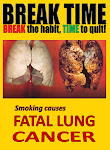
Photo designed by Break Time